I often open a trend page in the morning and mentally file it as “what people are talking about today.” The database suggests that is too generous. On several feeds, the morning list is already a poor guide to what will be visible by dinner.
We matched each source's saved top 20 near 09:00 with its saved top 20 near 18:00 on the same day. The median carry-over ranged from 0% on Weibo to 80% on V2EX. Put another way, the label “today's trends” hides several very different clocks.
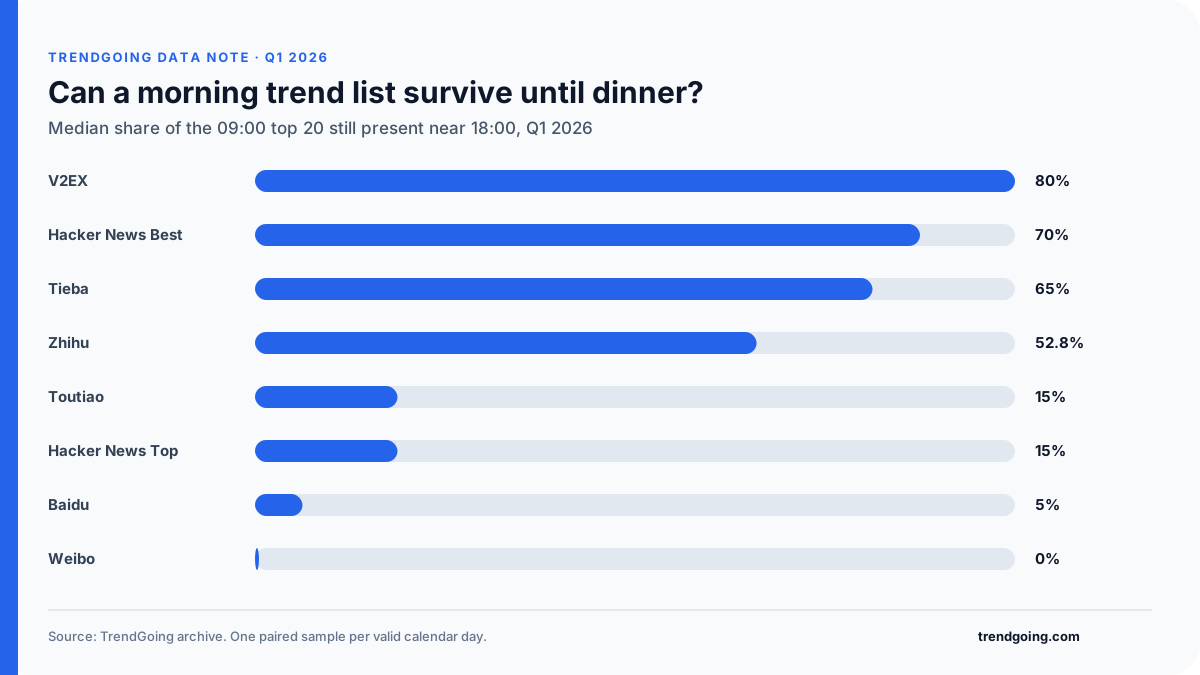
A list can change without the day changing
The date printed above a ranking is not a guarantee that the ranking describes the whole date. Breaking news, entertainment releases, sports results and platform-specific discussions all arrive on their own schedules. A morning capture is a timestamped observation, not a daily summary.
| Source | Median retained | Valid days |
|---|---|---|
| V2EX | 80% | 90 |
| Hacker News Best | 70% | 88 |
| Tieba | 65% | 90 |
| Zhihu | 52.8% | 90 |
| Toutiao | 15% | 90 |
| Hacker News Top | 15% | 89 |
| Baidu | 5% | 90 |
| 0% | 90 |
This matters when a trend list becomes an editorial source. If the feed has low morning-to-evening retention, an article drafted at lunch should recheck both the rank and the underlying source before publication. A headline can remain true even after it leaves the list, but the claim that it is “currently trending” may not.
What the comparison does not show
We compared internal item IDs, not audience size. A retained item could move from rank 1 to rank 20, and a rewritten headline could receive a different ID even when the underlying event is the same. The result measures the visible composition of our saved lists. It does not measure how many people saw, searched for or believed a topic.
Collection frequency also differs by source. To prevent a frequently captured feed from contributing more daily comparisons, we allowed at most one morning and one evening observation per date. If either was more than 90 minutes from its target time, that date was omitted.
A better way to read a morning board
Use it as a watchlist. Save the observation time, open the original platform, and check again before making a broad claim. If an item survives until evening, that is evidence of persistence. If it disappears, the morning snapshot still documents a real moment—but not an all-day consensus.