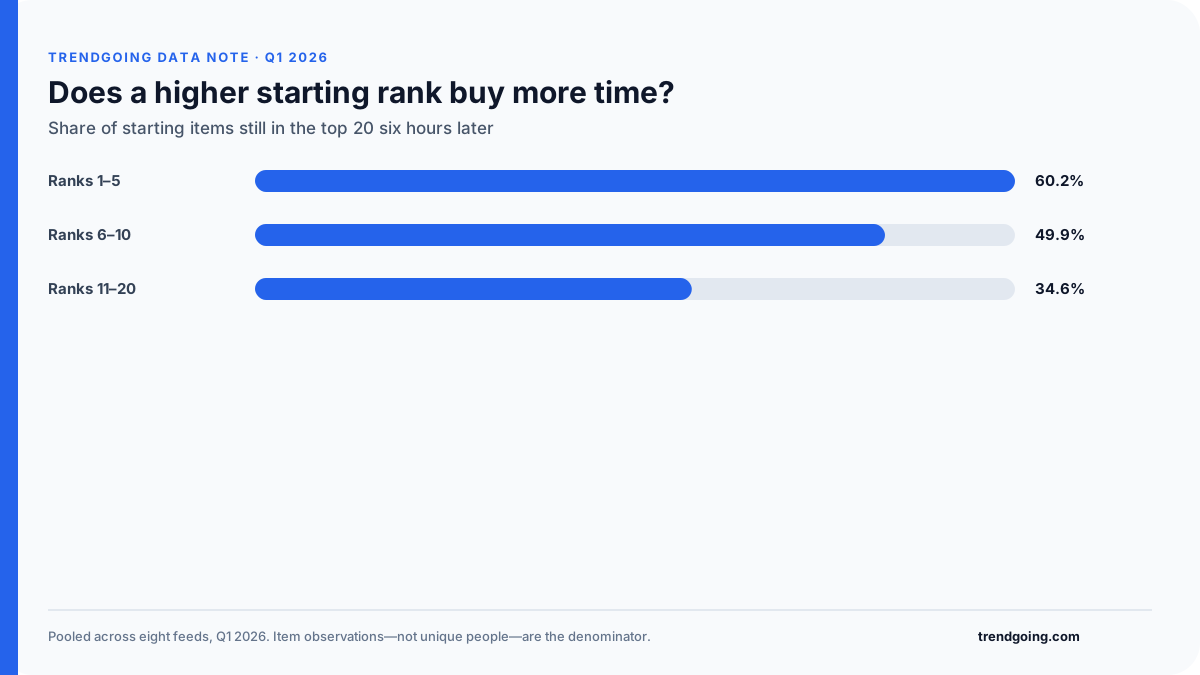
Rank number one attracts the screenshot, but the more useful question is whether a high starting position buys time. Across eight saved feeds, it did: items beginning in ranks 1–5 remained inside the top 20 six hours later more often than items beginning in ranks 11–20.
The pooled survival rate was 60.2% for ranks 1–5 and 34.6% for ranks 11–20. This does not tell us why an item lasted. It gives us a practical prior: starting position contains some information about persistence, but it is not a promise.
What counts as survival?
An item did not need to keep its original rank. A topic starting at number two and falling to number nineteen still counted as present. An item starting at number nineteen and rising to number four also counted. The test asks whether the item remained visible inside the common top-20 window.
That definition is intentionally forgiving. It separates disappearance from movement and avoids treating every small rank change as a new event. It also makes feeds of different depths more comparable because we never use positions below 20.
| Source | Ranks 1–5 | Ranks 6–10 | Ranks 11–20 |
|---|---|---|---|
| 24.1% | 12.5% | 12.8% | |
| Tieba | 94.1% | 92.7% | 55.5% |
| Toutiao | 32% | 20.9% | 23.9% |
| Baidu | 35.8% | 25.3% | 20.6% |
| Hacker News Top | 74.5% | 49.7% | 17.1% |
| Zhihu | 82.9% | 66.2% | 41% |
| Hacker News Best | 83% | 84.3% | 80.1% |
| V2EX | 76.1% | 71.1% | 47.6% |
Do not confuse persistence with importance
A lasting item can be repetitive, entertaining or mechanically favored. A short-lived item can still be consequential. Rank survival measures what the list kept displaying, not what readers should care about. Editors still need primary sources and subject judgment.
The calculation also counts observations rather than unique topics. A long-running item can appear in multiple starting pairs. That is appropriate for the question “if I see an item at this rank now, what usually happens six hours later?” It would not be appropriate for estimating the number of distinct events.
A simple newsroom rule
Use starting rank to set a follow-up time, not to write a conclusion. High-ranked items deserve a second check because they are more likely to remain visible. Lower-ranked items need faster evidence capture if they matter to your beat. In both cases, the ranking is a prompt to investigate rather than a substitute for reporting.