Weekends are supposed to be slower. That assumption is common enough that editors plan lighter coverage and researchers expect calmer dashboards. The archive gives a less tidy answer: some lists retained more items on Saturdays and Sundays, while others barely changed their pace.
We took the first non-empty capture in each observed hour and looked for another capture exactly six hours later. For each pair, we measured how many of the starting top 20 were still present. The starting date determined whether the pair belonged to the weekday or weekend group.
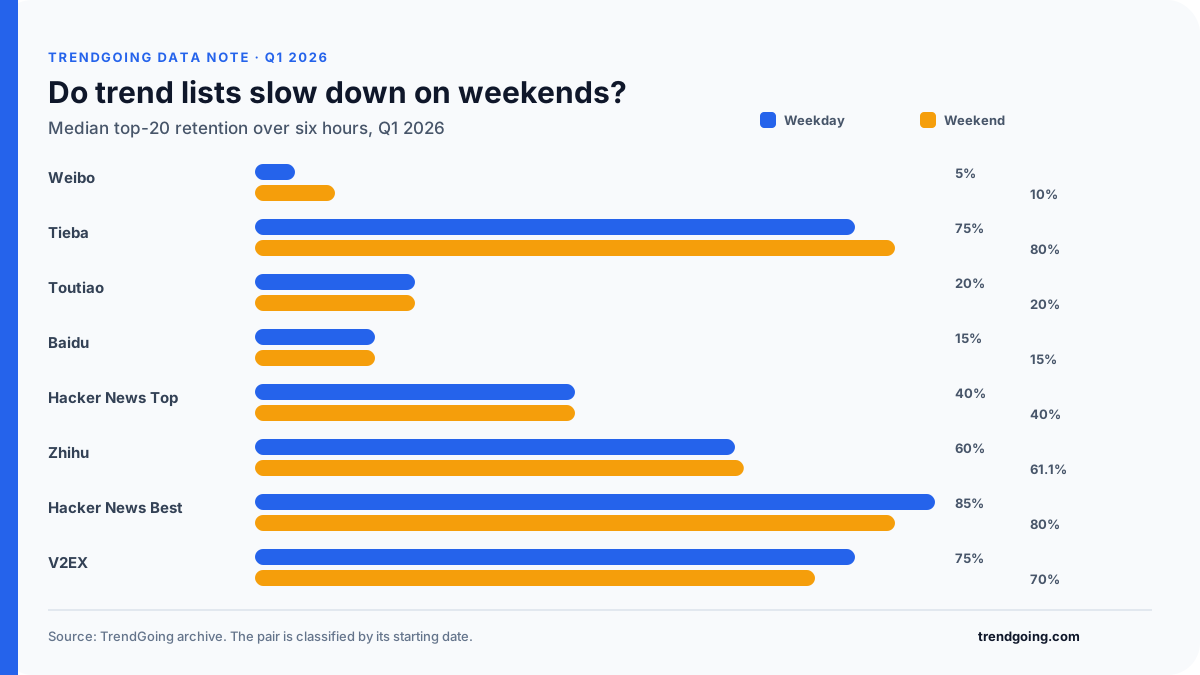
The weekend effect is not universal
A single “internet attention cycle” would produce roughly the same weekend direction everywhere. We do not see that. The feeds reflect different audiences, content types and ranking systems. Sports, consumer news, technical discussion and general search do not share one weekly timetable.
| Source | Weekday | Weekend | Difference |
|---|---|---|---|
| 5% | 10% | +5 points | |
| Tieba | 75% | 80% | +5 points |
| Toutiao | 20% | 20% | 0 points |
| Baidu | 15% | 15% | 0 points |
| Hacker News Top | 40% | 40% | 0 points |
| Zhihu | 60% | 61.1% | +1.1 points |
| Hacker News Best | 85% | 80% | -5 points |
| V2EX | 75% | 70% | -5 points |
The table is best read row by row. Comparing a platform with itself controls for list depth and much of its ranking design. Comparing absolute percentages across platforms is less clean because one feed may expose 19 positions while another consistently exposes 50.
Why this matters in practice
A weekend monitoring schedule should be based on the source, not a blanket rule. A feed whose six-hour retention falls on weekends may need the same checking rhythm as a weekday. A feed whose retention rises can support a slower review cycle, although breaking events can still overturn the pattern on any individual day.
The result also changes how weekly summaries are assembled. If an editor samples only Monday through Friday, a platform with distinctive weekend turnover will be systematically underrepresented. A small Sunday checkpoint may preserve stories that disappear before the working week begins.
Limits before conclusions
This is a calendar comparison, not a causal experiment. Holidays, major launches and news cycles are unevenly distributed across a 90-day window. We do not claim that the weekend caused any change. We report the observed difference and leave the calendar visible so the analysis can be rerun on another quarter.